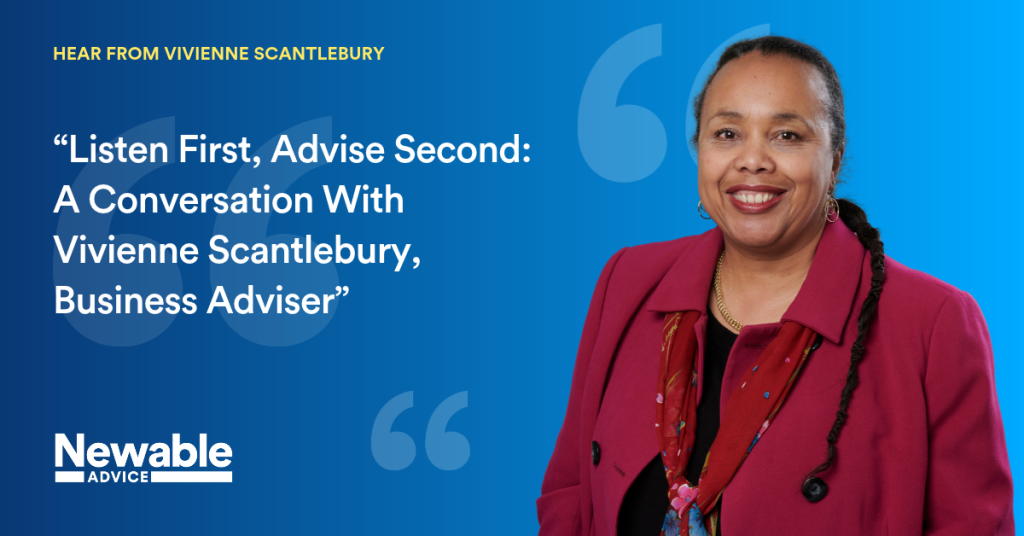
In this interview, we sat down with Vivienne, one of our Business Advisers at Newable Advice, to delve into her professional experience and the pivotal role she plays in supporting our clients on their growth journey.
Vivienne Scantlebury brings a wealth of experience across banking, small-business support, business finance, mentoring, international growth and innovation. In this spotlight, she explains how that breadth helps her look at a business as a whole, test what really needs attention and turn competing priorities into practical next steps.
Tell us a little about what you do and the businesses you support.
I support SMEs, start-ups, innovation-led companies and growth-focused businesses at different stages of their development. Some founders are testing an idea or preparing to start trading. Others have an established business and need to strengthen the foundations to access finance, innovate, enter new markets or prepare for their next stage of growth.
My role is to help them identify the opportunities and challenges in front of them and assist them in the development of a strategy and activities which will support their growth ambitions. That can involve business and financial planning, access to finance and fundraising, marketing, routes to market, business growth strategy, mentoring and internationalisation.
My background has given me a broad view of how businesses operate. I began in banking and held roles including Customer Services Officer, Assistant Manager, Area Business Adviser and Retail Bank Manager at NatWest. Since joining Newable Advice, I have managed and delivered business-support projects, worked with pre-start and trading businesses, supported applicants preparing business plans and cash flows for start-up finance, and helped SMEs explore international growth.
Today, I work with ambitious businesses on innovation and growth. Although each company is different, the starting point is always the same: understand where the business is now, where the founder wants it to go and what needs to change to help them move forward.
What’s your approach to understanding what the business or founder you are supporting really needs?
My approach is to listen first and advise second.
I begin with the founder’s ambitions, the current position of the business, what they are trying to achieve and what they see as the immediate challenge. I then use open questions to get beneath that first request, because the issue a founder presents is not always the underlying issue that needs addressing.
I look at the business holistically. A question about funding may also raise issues around pricing, cash flow, the commercial model or readiness for investment. A growth ambition may depend on customers, people, processes, partnerships, routes to market or the founder’s capacity to deliver it. Looking at those connections helps us avoid treating one symptom in isolation.
I also create space for the founder to step back from day-to-day pressures and to think strategically and identify workable solutions. I will validate their thinking where appropriate, but I am equally prepared to challenge assumptions and ask difficult questions by analysing with them any barriers which could be restricting growth within the business.
From there, we agree on the priorities most likely to make a difference and turn them into practical actions. I do not believe in a one-size-fits-all approach. The support must reflect the founder, the stage of the business and the outcome they want to achieve. As the business develops, we revisit those priorities because its needs will change.
Where do you find your expertise can make the biggest difference for a founder or business leader?
I often add the most value when a founder has a great deal of energy and ambition, but also many ideas, decisions and competing priorities. When everything feels important, it can be difficult to identify what needs attention first.
My role is to advise on what priorities, if not completed, will have the biggest impact, and how the outcome of an activity can link into another. Founders have highlighted that having a listening ear to explore a multitude of priorities and putting them into perspective has been very helpful.
That is where the combination of financial understanding, commercial experience and mentoring can make a real difference. I can help a founder step back, connect the different parts of the business and test whether the evidence supports the direction they are considering. Sometimes, that means clarifying the business model or financial assumptions. At other times, it means focusing the route to market, exploring finance or partnership opportunities or deciding what the business is not yet ready to pursue.
Through my experience of supporting a variety of businesses across different sizes and sectors, I am able to advise the founder in the following areas:
- Do they have the required processes and systems to ensure that they are market ready?
- Do they have a robust supply chain as well as the resources to deliver internal and external activities?
- Have they identified marketing and partnering opportunities to enable the development of routes to market?
This helps the founder gain the clarity to make the right decision for their business, with practical actions they understand and own.
What do you enjoy most about supporting clients?
I enjoy seeing the moment when a founder moves from feeling overwhelmed or uncertain to having a clearer sense of direction. That shift may come from asking a question they have not considered before, helping them organise competing priorities or giving them the confidence to take the next practical step.
I also value the opportunity to understand the purpose behind a business. Founders often bring more than a commercial ambition. They may be trying to solve a real problem, create opportunities or build something that reflects deeply held values. The support is stronger when those motivations are understood rather than treated as separate from the business strategy.
One of the most rewarding parts of the role is building the trust that allows an adviser to both encourage and challenge. Founders do not always need someone to agree with them, but they do need someone who listens carefully, takes their ambition seriously and is prepared to ask the questions that help move the business forward.
As an Adviser, I also like to celebrate the positive outcomes achieved from the businesses that I support, as this provides a real sense of achievement knowing I have helped a business move forward with their growth journey.
Client feedback has reinforced how important that combination can be. Practical guidance matters, but so do consistency, encouragement and the confidence a founder gains from knowing that someone understands what they are trying to build.
What’s one piece of advice you’d give to a business looking to move on to its next stage of growth?
Don’t grow for growth’s sake.
Be clear about what you want the next stage of growth to achieve. Is the priority stronger revenue, greater resilience, a new market, a more scalable operation or increased social impact? The answer will shape the opportunity you pursue and the resources you commit.
Then, test whether the business is ready. Look honestly at the finances, customer demand, people, systems, leadership capacity and delivery requirements. Growth can expose weaknesses as quickly as it creates opportunities, so the foundations matter.
Focus your time and resources on the opportunities that best support the ambition, rather than trying to pursue everything at once. Step back regularly, review the priorities and do not be afraid to seek informed challenge along the way.
Purposeful growth is not simply about doing more. It is about making deliberate decisions that leave the business stronger and better equipped for what comes next.